Pablo Picasso Spanish, 1881-1973
Overview
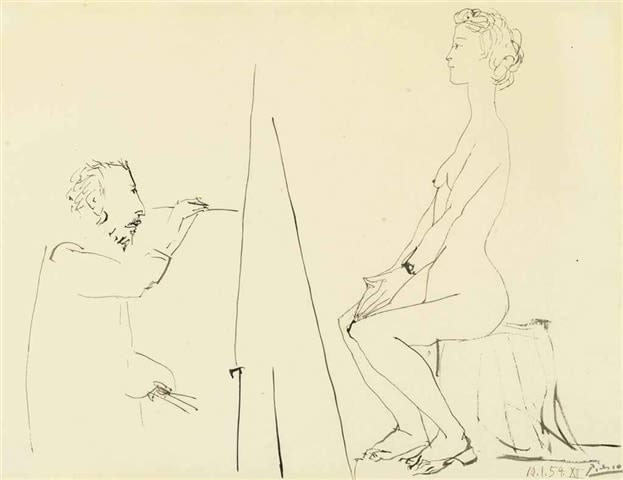
Peintre et Modele, 1954
Pablo Picasso was one of the most influential artists of the 20th century, whose relentless experimentation reshaped the course of modern and contemporary art. Over a career spanning more than seven decades, he worked across painting, sculpture, printmaking, ceramics, and writing, continually challenging artistic conventions. Picasso’s practice evolved from the naturalism of his early years to the radical innovations of Cubism and beyond, reflecting an extraordinary capacity for reinvention.
Living through two World Wars, Picasso maintained a prolific and multifaceted life, producing an immense body of work while engaging deeply with the cultural and political currents of his time. His early production is often understood through a series of distinct periods, including the Blue Period (1901–1904), the Rose Period (1904–1906), the African-influenced period (1907–1909), Analytic Cubism (1909–1912), and Synthetic Cubism (1912–1919), also known as the Crystal period.
In the late 1910s and early 1920s, Picasso turned toward a neoclassical idiom, while his work of the mid-1920s increasingly engaged with Surrealism. In his later decades, he freely combined elements from earlier phases, producing a body of work that is both reflective and radically inventive.
By 1936, the outbreak of the Spanish Civil War had profoundly affected Picasso, an experience that culminated in Guernica (1937), one of the most powerful political statements in 20th-century art. In 1944, Picasso joined the Communist Party, reflecting his deepening political commitments. From the late 1940s onward, he lived primarily in the South of France. Among the many major exhibitions held during his lifetime, those at The Museum of Modern Art, New York, in 1939 and the Musée des Arts Décoratifs, Paris, in 1955 were particularly significant. In 1961, Picasso settled in Mougins, where he continued to work prolifically in painting, drawing, printmaking, ceramics, and sculpture until his death on April 8, 1973.
Works
-
 Peintre et Modele, 1954
 -
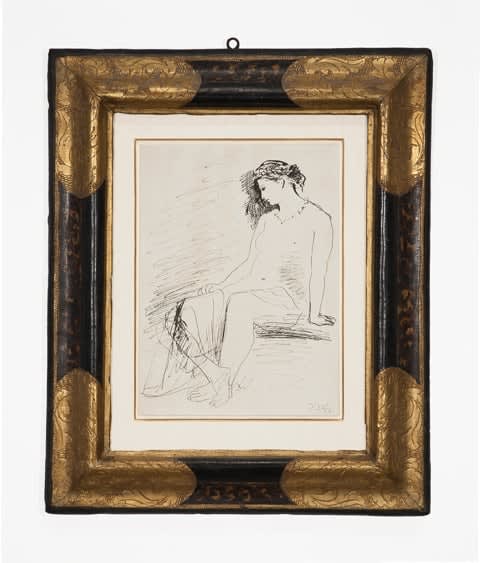
Femme nue assise, 1925